A marine robot can spend hours underwater where a diver may have limited time, poor visibility, or safety risks. That makes robots useful for checking habitats, tracking pollution, and inspecting structures while people stay on the surface and make the hard decisions.
- Longer watch: autonomous systems can repeat surveys across the same area.
- Safer inspection: remotely operated vehicles can work near wrecks, cables, and damaged equipment.
- Better records: cameras and sensors create time-stamped evidence for later review.
Where robots fit in ocean work
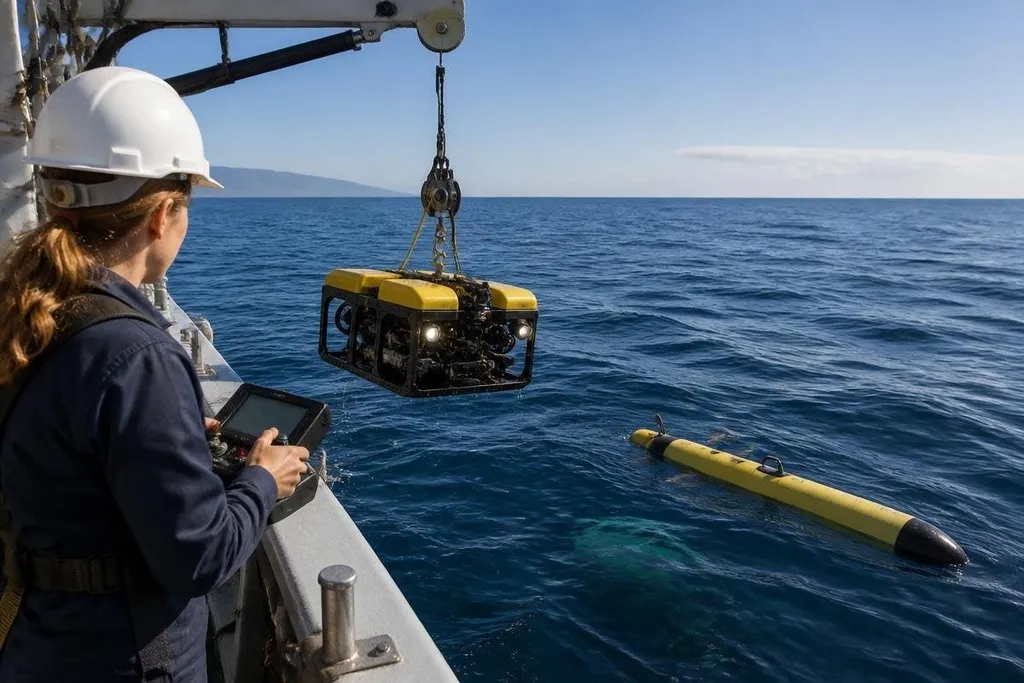
Marine robots come in several forms. A remotely operated vehicle, or ROV, receives power and commands through a cable from a ship. An autonomous underwater vehicle, or AUV, carries its own battery and follows a planned route without a constant control link.
That difference changes the job. An ROV suits close inspection because an operator can steer toward a valve, crack, or animal. An AUV suits repeated mapping because it can cover a set area and return with images or sensor readings.
Surface robots add another option. They can carry cameras, water sensors, or radio equipment while moving across the sea. Some systems can also act as a link between underwater robots and a control team, since radio signals travel poorly through seawater.
Four jobs that matter
Robots can help in ocean protection when the task depends on regular observation rather than a single visit.
Mapping habitats gives scientists a record of reefs, kelp beds, seagrass, and the seabed around them. Sonar can map areas where sunlight does not reach.
Cameras record visible life and damage, while repeated trips along the same route can show whether a place is changing.
Checking pollution requires more than a water sample from one point. A robot can carry sensors through several parts of a site and collect readings at different depths. People still need to check the results, but the robot can cover more water than a diver with a handheld instrument.
Watching animals is another useful task. A quiet robot can record video without placing a person in the water beside the animal. The machine must still keep a safe distance, avoid contact, and make enough noise to avoid changing the behavior being studied.
Inspecting infrastructure protects the ocean in a less direct way. Robots can check offshore platforms, pipelines, cables, and ship hulls for damage. Finding a problem early may reduce the chance of leaks or a larger repair, though the robot itself cannot fix every fault.
For marine robot trials, marine robotics reporting from Robot24.com records the model, depth, test site, and date behind each result. Those details show whether the robot worked in open water or under controlled conditions, which matters before the limits below the surface.
The limits below the surface
Water blocks radio signals, reduces visibility, and adds pressure as depth increases. An underwater robot may need to follow a planned route for much of its mission, then return to a known point before its battery runs low.
That makes recovery part of the design. A lost vehicle can become debris, and recovering it may require another vessel, another robot, or a diver. Every mission also needs a way to check that the sensor readings are accurate.
Autonomy brings another concern. Software can spot patterns in images or keep a vehicle on a route, but it may misread silt, plants, animals, or a damaged structure. A human team should set the task, review the data, and decide what action follows.
The other concern is disturbance. Thrusters can stir the seabed, lights can affect animals, and repeated passes can change a fragile site. A robot that collects data while damaging the place being studied has failed its main task.
A practical choice guide
Before choosing a marine robot, check these points:
- Define the site: record depth, currents, visibility, temperature, and access from shore or ship.
- Match the vehicle: choose an ROV for close control or an AUV for planned survey work.
- Set the sensor list: carry only the cameras and sensors needed for the decision.
- Plan recovery: mark launch, return, tracking, and retrieval steps before the mission.
- Review the data: assign people to check images, sensor readings, and location records.
- Measure disturbance: watch for noise, seabed contact, light effects, and changes in animal behavior.
I'd fund repeatable survey missions before buying a more autonomous machine. A clear record gathered across the same route can help protect an ocean site more than a costly demo that runs once.
The next test is practical: can a marine robot gather reliable data for months while keeping its own noise, energy use, and recovery risk low?